
Fixed or Variable Rate: The 2026 Mortgage Dilemma.

If there is one conversation dominating coffee shops and dinner tables across Penticton and the broader Okanagan Valley this year, it is real estate—and more specifically, how to finance it. Whether you are a first-time homebuyer trying to break into the BC housing market, or a current homeowner staring down a fast-approaching mortgage renewal, you are likely wrestling with the same critical question: Should I lock into a fixed-rate mortgage, or ride the wave of a variable rate?
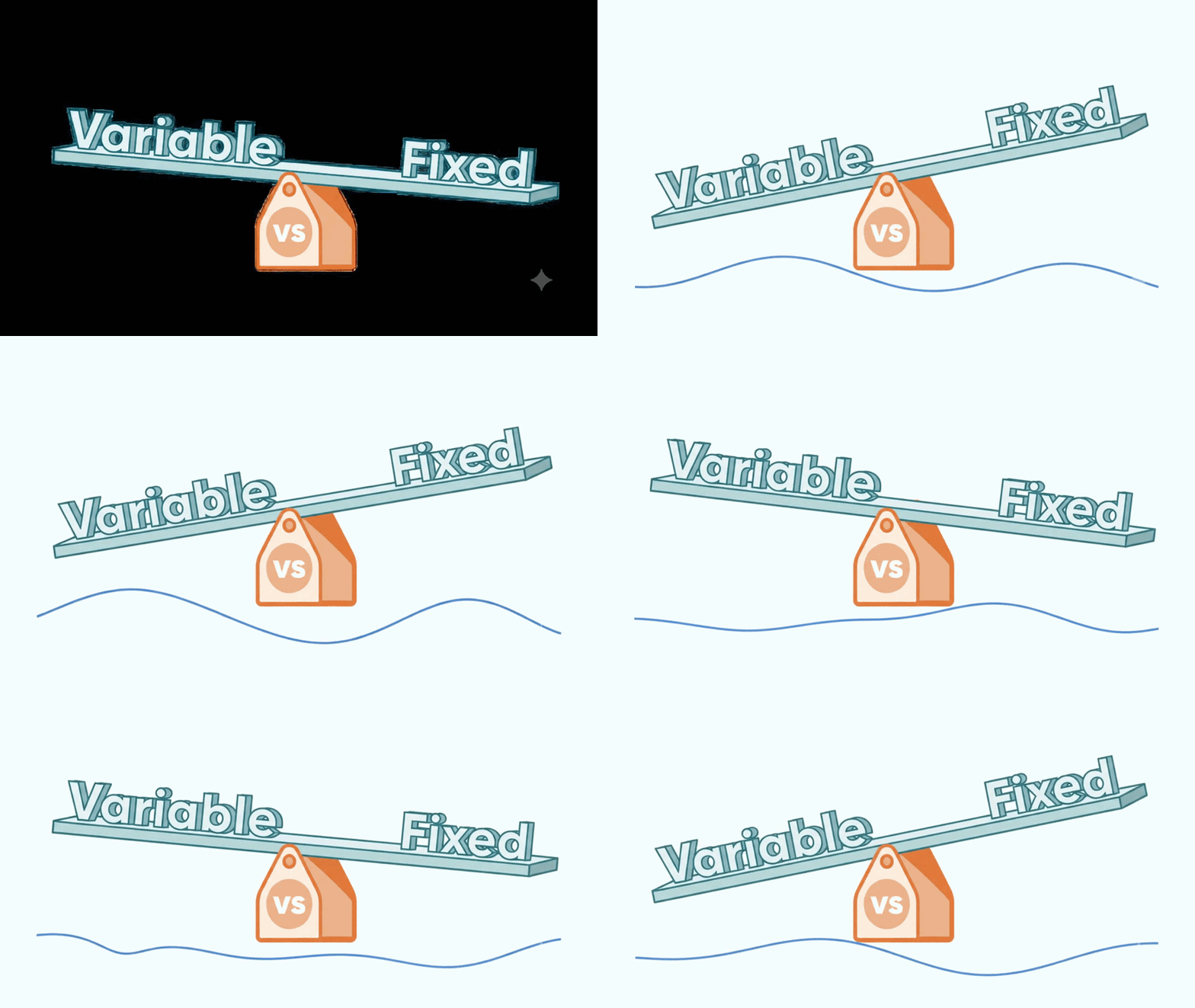
We are currently navigating a fascinating—and at times, frustrating—economic landscape in the latter half of 2026. The days of sub-2% pandemic interest rates are firmly in the rearview mirror, but so are the chaotic, rapid-fire rate hikes of 2022 and 2023. Today, the market has settled into a new normal, but it is a normal fraught with unique geopolitical and economic pressures.
In this comprehensive guide, we are going to look under the hood of the current Canadian mortgage market. We will analyze the data, break down the mechanics of fixed and variable rates, and explore how macroeconomic factors like U.S. trade policies and global oil prices are directly impacting your monthly housing costs right here in British Columbia.
By the end of this article, you won't necessarily be told what to do—because every financial situation is deeply personal—but you will have the data-driven framework required to make the smartest possible choice for your household.

The Macro Environment: What is Driving Rates in 2026?
To understand where mortgage rates are going, we first have to understand where they come from. The Canadian mortgage market does not operate in a vacuum; it is highly sensitive to both domestic inflation and global economic currents.
As of August 2026, the Bank of Canada’s (BoC) prime rate currently stands at 4.45%. This benchmark rate is the foundation upon which all variable-rate mortgages are built. After the historic inflation battle that saw the prime rate pushed to a 22-year high post-pandemic, the BoC has managed to bring rates back down to what economists consider "normal" historical levels.
However, "normal" does not mean "stable." Two major macroeconomic wildcards are currently keeping the Bank of Canada on high alert:
Energy Inflation: The recent geopolitical disruptions, particularly the U.S.-Iran tensions, have heavily disrupted the global oil supply. When oil prices spike, the cost of transporting everything from groceries to building materials spikes with it. This creates upward pressure on inflation.
U.S. Trade Disruptions: Canada is currently navigating a complex trade war environment with the United States. Tariffs and supply chain bottlenecks naturally increase the cost of consumer goods, which again, stokes the fires of inflation.
If inflation begins to heat up again due to these factors, the Bank of Canada may be forced to hike the prime rate later this year or early next year to cool the economy. Conversely, if these trade disruptions severely weaken the Canadian economy and consumer demand plummets, the BoC might cut rates to stimulate growth.
This tightrope walk is the exact reason why the fixed vs. variable debate is so highly contested right now.
Deep Dive: The Mechanics of a Fixed-Rate Mortgage
A fixed-rate mortgage is exactly what it sounds like: your interest rate and your monthly payments are locked in for the entire duration of your term (most commonly 5 years).
Currently, a competitive 5-year fixed rate is sitting around 4.14%.
How Fixed Rates are Determined
Unlike variable rates, which track the Bank of Canada's prime rate, fixed mortgage rates are tied to the Canadian bond market—specifically 5-year Government of Canada bond yields. When investors get nervous about inflation or economic instability, bond yields rise, and banks immediately raise their fixed mortgage rates to compensate. Because of the current trade and oil supply uncertainty, bond yields have been fluctuating within a tight range, keeping fixed rates hovering just above the 4% mark.
The Pros of Going Fixed
The "Set It and Forget It" Budget: This is the ultimate tool for financial peace of mind (often referred to as JOMO—the Joy of Missing Out on rate stress). You know exactly what your payment will be on the 1st of every month for the next five years, making budgeting incredibly predictable.
Protection from Inflation Shocks: If global oil prices cause domestic inflation to spike and the BoC raises rates, you are entirely shielded from the fallout until your renewal date.
The Cons of Going Fixed
Higher Starting Rates: Currently, fixed rates are higher than variable rates. By choosing a fixed rate, you are paying a "premium" for security.
Harsh Break Penalties: This is the biggest hidden trap of a fixed mortgage. If you need to sell your home, refinance, or break your mortgage before your 5-year term is up, banks will charge you a penalty based on the Interest Rate Differential (IRD). Depending on how much rates have changed, this penalty can easily amount to tens of thousands of dollars.
Deep Dive: The Mechanics of a Variable-Rate Mortgage
Variable-rate mortgages fluctuate based on the Bank of Canada's prime rate. When you sign a variable mortgage, you are essentially agreeing to a set "discount" or "premium" on the prime rate.
For example, a lender might offer you a rate of Prime minus 0.96%. With today’s prime rate at 4.45%, your actual mortgage rate would be 3.49%. Crucially, while the prime rate can go up or down during your 5-year term, your discount (-0.96%) is locked in forever.
ARM vs. VRM: A Critical Distinction
Not all variable mortgages function the same way. It is vital to know which one your lender is offering:
Adjustable-Rate Mortgage (ARM): Your monthly payment changes every time the BoC changes its rate. If rates drop, your monthly payment instantly goes down, providing immediate budget relief.
Variable-Rate Mortgage (VRM): Offered by many large banks, your monthly payment stays exactly the same, but the composition of the payment changes. If rates go up, more of your money goes toward interest and less toward the principal, effectively extending your total amortization (how long it will take to pay off the house). If rates rise high enough, you may hit a "Trigger Rate," which is the mathematical point where your payment no longer covers the interest, forcing the bank to unilaterally increase your monthly payment.
The Pros of Going Variable
Lower Starting Rates: Today, a 5-year variable rate is roughly 0.65% lower than a 5-year fixed rate. This spread provides immediate monthly savings.
Historical Advantage: Historically speaking, variable-rate holders tend to pay less interest over the 25-year life of a mortgage compared to fixed-rate holders.
Flexibility: If you need to break a variable mortgage, the penalty is almost always capped at just three months of interest. If there is a chance you might move, sell, or refinance in the next five years, variable is vastly safer from a penalty perspective.
The Conversion Option: Most lenders allow you to convert your variable rate into a fixed rate at any point during your term without a penalty, providing an "eject button" if the market gets too turbulent.
The Cons of Going Variable
Payment Shock: If inflation surges and the BoC raises rates, your payments (or your amortization timeline) will increase.
Psychological Stress: You have to actively monitor the news. Every Bank of Canada announcement becomes a source of anxiety (FOMO—the Fear of Missing Out on the safety of a fixed rate).
The Okanagan Context: Penticton and Beyond
Real estate is hyper-local, and how you approach your mortgage should reflect the realities of the BC market.

For the First-Time Homebuyer
The Okanagan Valley, and Penticton in particular, remains highly desirable. We are seeing a steady influx of remote workers, retirees, and young professionals looking for a lifestyle upgrade. For first-time buyers trying to pass the federal mortgage stress test (which requires you to prove you can afford a rate 2% higher than your contract rate), the lower starting point of a variable rate (3.50%) can sometimes make the math a little easier to digest than a fixed rate (4.14%).
However, first-time buyers are also the most vulnerable to payment shocks. If your budget is stretched to the absolute maximum just to get into a townhouse in Penticton, you may not have the financial buffer required to absorb a variable rate hike. For these buyers, the fixed rate is often the safest path to retaining homeownership.
For the Renewing Homeowner
If you bought your home in 2021, you likely secured a 5-year fixed rate somewhere around 1.99% to 2.49%. As you approach your renewal in 2026, you are facing a reality where your rate is going to double.
Many renewing homeowners in BC are leaning heavily into variable rates right now. Because their principal has been paid down over the last five years, they have more equity and more financial breathing room. They are willing to take the variable rate today to capture the 0.65% spread, banking on the hope that if the economy softens, the BoC will cut rates, bringing their mortgage costs down even further over the next few years.
The Numbers Game: What Does the Spread Actually Mean?
Let’s look at the hard data. The current spread between the best fixed and variable rates is approximately 0.65% (4.14% Fixed vs. 3.49% Variable).
Let's assume you have a $600,000 mortgage on a property in the South Okanagan, amortized over 25 years.
At a Fixed Rate of 4.14%: Your monthly payment is locked in at roughly $3,200. You will pay this exact amount for 60 months.
At a Variable Rate of 3.49%: Your starting monthly payment is roughly $2,980.
Right out of the gate, the variable rate saves you $220 per month in cash flow. Over the first year alone, that is $2,640 in savings.
But what happens next?
Scenario A (Rates stay flat): You save over $13,000 in cash flow over the 5-year term compared to the fixed rate.
Scenario B (Rates drop by 0.50% next year): If the economy slows and the BoC cuts rates, your payment drops further. You could easily net over $18,000 in savings by the end of the term.
Scenario C (Rates rise by 0.75%): If inflation spikes and the BoC hikes rates three times, your variable rate jumps to 4.24%—surpassing the fixed rate. Your savings evaporate, and you end up paying slightly more over the term than if you had locked in.
Want to run your own numbers? Use this interactive tool to visualize exactly how the current fixed and variable spreads would impact your specific mortgage amount.
FOMO vs. JOMO: The Psychology of the Choice
Ultimately, choosing between a fixed and variable rate in 2026 is an exercise in assessing your own risk tolerance. The math can only tell you what is happening today. No economist, algorithm, or mortgage broker has a crystal ball that can predict exactly what global oil markets or U.S. trade policies will do three years from now.
Choosing a variable rate means embracing FOMO (Fear of Missing Out). You are afraid of locking into a 4.14% fixed rate today, only to watch rates drop to 2.99% next year, leaving you trapped in an expensive contract. You choose variable to ensure you don't miss out on potential downward trends.
Choosing a fixed rate means embracing JOMO (Joy of Missing Out). You are happy to give up potential savings in exchange for certainty. You don't want to wake up, read a headline about global supply chain disruptions, and immediately worry about how it will affect your ability to pay for groceries. You pay a slight premium for the joy of tuning out the economic noise.
The Verdict: How to Move Forward
There is no objectively "wrong" choice in today’s market, only the choice that aligns improperly with your financial reality.
If you have a tight household budget, lose sleep over financial news, or have absolutely no plans to move in the next five years, the stability of a fixed rate is incredibly compelling right now. Sub-5% historical rates are still highly manageable over the long term.
If you have a buffer in your monthly budget, intend to aggressively pay down your principal, or might need to sell your home/relocate within the next 3 to 4 years, the flexibility and current monthly cash-flow savings of a variable rate make it the mathematical front-runner.
You don't have to navigate this alone.
Whether you are looking to buy your first home in Penticton, upgrading to a larger property in the Okanagan, or just trying to navigate a scary renewal letter from your current bank, professional, data-driven advice is your best asset. The rate is only one part of the mortgage—the terms, conditions, and penalties buried in the fine print can cost you far more than a fraction of a percent in interest.
If you are ready to stop guessing and start strategizing, let's look at your specific numbers. Book a call with me today, and together we will build a mortgage strategy that protects your budget, builds your wealth, and lets you sleep soundly at night.
About the Author

Stephen Aitcheson is a mortgage broker based in Summerland, BC, serving homebuyers and homeowners throughout Penticton and the South Okanagan. Through XEVA Mortgage, Stephen helps clients with home purchases, self-employed mortgages, refinancing, construction financing and complex mortgage solutions.
We always do our best to ensure that all information provided is accurate at the time the article was published but as government regulation along with lender rule and requirements change frequently it is always best to contact your local mortgage broker. This will ensure you have the most up to date information and that your mortgage plan is built around your unique financial position as well as current and future goals. Contact me for to get a your free mortgage plan Stephen Aitcheson Mortgage Solutions


Comments